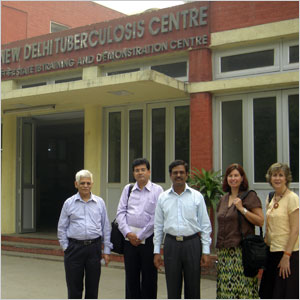
 Indian Laboratory Visit / Photo by ASM
|
 |
ASM LabCap Programs
U.S. President's Emergency Plan for AIDS Relief Initiatives (PEPFAR)Under a multi-year Cooperative Agreement with the Centers for Disease Control and Prevention (CDC), ASM is collaborating with the CDC's Global AIDS Program (GAP) on capacity building of global HIV and clinical microbiology laboratories in resource-limited countries throughout the world in support of the U.S. President's Emergency Plan for AIDS Relief (PEPFAR) initiatives. Under the direction of the U.S. Global AIDS Coordinator's Office, CDC/GAP is a partner in the unified U.S. Government effort to implement PEPFAR. CDC's long-standing partnerships with Ministries of Health support improvement of critical infrastructure and services to build sustainable national public health capacity and help resource-constrained countries prevent HIV infection; improve treatment, care, and support for people living with HIV. LabCap support has focused primarily on tuberculosis (TB) and other HIV/AIDS opportunistic infection (OI) diagnostic strengthening. LabCap consultants travel to countries in regions such as sub-Saharan Africa, Southeast Asia, and the Caribbean. Consultants provide onsite technical assistance. Ongoing activities include:
International Emerging Infections Program Initiatives (IEIP)ASM is collaborating with the CDC's Global Disease Detection Program, CDC—COGH Global Disease Detection, in order to assist with one of its core components, the International Emerging Infections Program (IEIP). The IEIP is a collaboration between the CDC and a host country to develop and maintain centers of excellence that integrate four core activities: disease surveillance, outbreak investigation, capacity-building, and disease control and prevention. ASM is providing technical expertise and consultation for building laboratory capacity and improving clinical microbiology for the diagnosis of respiratory diseases in select IEIP sites. Each site will implement active, population-based surveillance for pneumonia with varying levels of microbiological capacity. An accurate assessment of the pneumococcal disease burden in the IEIP countries will allow for better characterization of potential benefits from routine use of existing or new pneumococcal vaccines. ASM-Program for Appropriate Technology in Health (PATH) Collaboration in IndiaASM is working with PATH in India under a United States Agency for International Development (USAID)-funded initiative to strengthen the capacity of the Intermediate Reference Laboratory (IRL) network (expected to expand to one IRL/state or territory, or over thirty laboratories) to perform Mycobacterium tuberculosis (Mtb) culture and drug susceptibility testing (DST). Collaboration objectives include:
Since November 2008, ASM LabCap, in collaboration with PATH, has been assisting the Indian Central TB Division (CTD). The ultimate goal of this assistance is to ensure that selected IRLs obtain national accreditation, i.e. be deemed fully proficient in Mtb culture and DST by an overseeing National Reference Laboratory (NRL). States (or territories) with accredited IRLs will then be able to conduct drug resistance surveys (DRS) and implement the DOTS-Plus strategy to treat multidrug resistant (MDR)-TB. Tuberculosis (TB) Indefinite Quantity Contract (IQC) partnership with Program for Appropriate Technology in Health (PATH), United States Agency for International Development (USAID)Through USAID's TB IQC, ASM partners with PATH to provide extensive support to USAID operating units in the implementation of their TB control and prevention programs through the introduction and expansion of the components of the World Health Organization (WHO)-recommended STOP TB Strategy, which include:
The TB IQC places special emphasis on Component 2, particularly MDR-TB prevention and control and strengthening TB laboratory capacity. The TB IQC provides cost-effective access to technical expertise and implementation support to meet evolving USAID needs, including:
Principal tasks of the TB IQC include:
|
