|
||||||||||||||||||
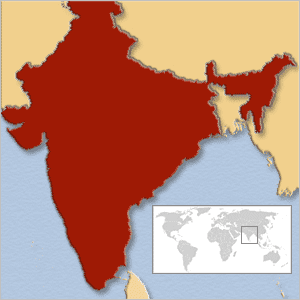

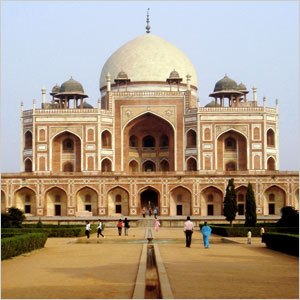
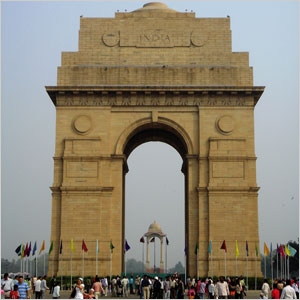
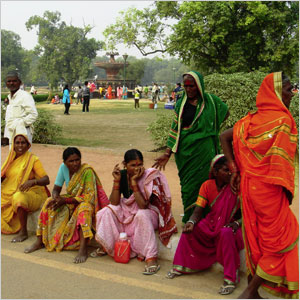
Ministry Foreign Affairs webpage India, the largest part of the Indian Subcontinent, extends from the Himalayan Mountains in the north, south into the tropical reaches of the Indian Ocean. It's the second most populous country on the planet, and certainly one of the most intriguing. In 1947, India declared independence from Britian. It is home to some of the most significant natural and man-made wonders on the planet. With numerous major languages (hundreds of dialects), dozens and dozens of large cities and over 700,000 villages - somehow India works, both in the classic, traditional methods of its many cultures, and in the fast-moving world of the 21st century. One of the most interesting architectural designs is The Taj Mahal. It was built between 1632 and 1653 by the Mughal Empire. It was the Emperor Shah Jahan's monument to his wife Mumtaz Mahal.  Amritsar Temple / Photo Credit |
 |
India
LabCap Objectives
Program HighlightsASM is working with the Program for Appropriate Technology in Health (PATH) in India under a United States Agency for International Development (USAID)-funded initiative to strengthen the capacity of the Intermediate Reference Laboratory (IRL) network (expected to expand to one IRL/state or territory, or over thirty laboratories) to perform Mycobacterium tuberculosis (Mtb) culture and drug susceptibility testing (DST). The ultimate goal of this collaboration is to ensure that selected IRLs obtain "accreditation", i.e. be deemed fully proficient in these activities by an overseeing National Reference Laboratory. States (or territories) with accredited IRLs will then be able to conduct drug resistance surveillances (DRS) and implement the Directly Observed Treatment Short-course (DOTS) Plus strategy to treat multidrug resistant (MDR)-TB. In practice, ASM/PATH's work in India entails developing customized laboratory evaluation tools, conducting detailed assessment of selected IRLs, elaboration of plans to build technical capacity in these laboratories, and provision of direct mentoring by ASM consultants to laboratory staff. ASM LabCap facilitated an IRL experience sharing workshop in New Delhi in July 2011. |
||||||||||||||||